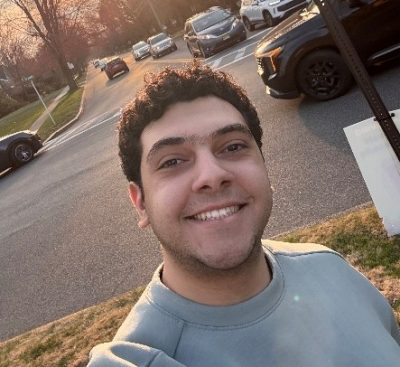
This article has been written by guest writer, Abdullah Elzawawy, who recently graduated from River Dell High School in Oradell, NJ. Abdullah has contributed to articles for the NJ Safe Routes to School Resource Center where he has written about discovering his urban planning passion and the role of high school students in Safe Routes to School programs and projects.
Thank you, Abdullah, for sharing your opinion and insights.
Withered houses, cracked bridges, graffiti-stained architecture, and the reek of gas. That was what it was like driving the Garden State Parkway. I remember sitting in the back seat of my Dad’s broad and boxy Ford Explorer, sinking deeper into its polished leather seats to dodge the aggressive atmosphere around me. It felt weirdly liminal, almost like a “non-place,” whenever we drove down those parts of the Garden State Parkway. Perhaps because the highway had literally plowed straight through people’s homes, it had an overbearing hostility that induced such a visceral reaction in me that I do not normally experience. Instinctively, I ignored the decaying life outside my dad’s Ford by rolling up the windows, making sure to hear the second click. I then escaped to the six-inch portal that was my phone. I do not remember exactly what drove me, but I decided to look up pictures of highways and road networks for fun (I was really bored). Well-designed highways and road infrastructure captivated me, and since I was deep in the mud of what clearly was not people-focused infrastructure, I wanted to compare America’s infrastructure to other places. Pictures of American roadways always looked hostile—the seas of gridlocked traffic, the convolution of interchanges stacked on top of each other. I had a gut feeling that this had to be a mistake of design, right? I mean, who actually looked at these pictures and thought “What a great, innovative piece of engineering!” I thought I was outlandish to think such a thing, because who was I to complain? Instead, I looked at what other countries did, sure that I would prove myself wrong that the American way was really the best in the world. I was met with counterintuitive designs—tree-lined roadways, bicycle paths, tramlines, continuous sidewalks, human-centered cities, well-organized arterial networks, throughways, fiettstraats, kolonihaves, and autobahns. I thought it was funny—it must suck to drive there. Yet as I looked up these different types of infrastructure, my cockiness faded. I was left in awe of how human these road networks looked. I made the mistake of holding my phone up to compare a random city in Europe to wherever we were on the Garden State Parkway, as I truly felt I had been transported to a third world country. The epiphany settled—the cars are the problem. I may not have known just how, but I knew I wanted to do something about it.
Accidental Urban Planner
I did not know what to call any of it. My entire “master plan” was just based off me looking at Wikipedia articles and schematics from Google Images under the search of “European road network design.” At odd hours, I would binge-watch urbanist videos, which pulled me deeper into a world unknown to me. Then came freshman year of high school. We were tasked with writing an editorial for our English Language and Composition class, researching our own ideas to talk about. I decided to write about what I learned in my own time and channel the frustration I had about car-centrism. “The Future is On Two Wheels” was the piece I handed in. My teacher, unexpectedly, loved it. She complimented me on my ability to sound so passionate. This assignment was during the New York Times’ Editorial Contest, and my teacher pushed me just to “shoot my shot” and hand my piece in. Unexpectedly, my editorial was given an “Honorable Mention,” which for someone who had not won anything before, was such a great feeling of accomplishment, almost like my frustration was finally heard. Sophomore year pushed me a bit further. I enrolled into my school’s Science Research class, where I was assigned a literature review of a topic that interested me. The very content I scrolled through was put in the spotlight as I wrote comprehensive reviews of YouTube videos alongside actual research papers. During this review, I uncovered the term “urban planning.” This was the very field that dictated the design choices of roads. Urban planners uphold the responsibility of implementing changes related to infrastructure when necessary. I initially thought planning was a subfield of engineering, to which I had the natural response of completely abandoning the idea of studying it. But the more I studied, I saw just how interdisciplinary urban planning was, and soon grew an affinity for it, despite no one around me really knowing what it was. Still to this day, my parents think I am “kinda like a civil engineer,” which I do not blame them for since there is no direct equivalent of “urban planning” in our mother tongue. Frankly, it seemed like there was no shortage of problems for urban planners to solve in America; like highways plowing through people’s homes, neighborhoods carved up by car-centrism, or communities stuck behind a slew of challenges no one seemed able to easily untangle. So, I decided to stop waiting and kickstart an idea in my own hometown of Oradell.
Grant and Oradell Avenue
The opportunity came from an unlikely place: a Facebook community page post. A worried parent posted her elementary school daughter’s strongly worded letter to the mayor complaining about the intersection of Grant and Oradell Avenues. Her scribbly handwriting noted the lack of any pedestrian infrastructure: no crosswalk, no pedestrian beacon, not even a crossing guard! From what I had learned from my literature review and research, I already had an idea of how to change this intersection for the better. Since it was a T-junction intersection with a high traffic count coming from Grant, my plan opted for a mini roundabout as the best remedy. A small one, no bigger than 10 feet in diameter, just to slow down drivers without stopping them, giving a better chance for Oradell Avenue drivers to merge smoothly. To address non-motorist conflicts, a delineated bicycle path as well as preceding speed tables and a raised intersection would give more priority to pedestrians like that elementary school student. Feeling confident in my “innovative” solution, I decided to reach out to the local council board to chime in and explain my ideas aloud. I assumed the position of an urban planner, albeit prematurely, and spoke in front of the council. Two members on the board expressed genuine interest but mentioned feasibility as well as cost. Stumped, but still tenacious, I stepped outside my comfort zone and called a rubber-company based in upstate New York. They constructed modular pieces of infrastructure, including mini roundabouts, with recycled plastic. It would cost $1500 to buy and ship the materials. The actual construction was the town’s responsibility. My vision was simple; the council would invest in this, community volunteers would help assemble the interlocking three-foot sections to make the outer ring of the roundabout, and we could fill the center with asphalt or cement so that kids from the elementary school could decorate it—a small, tangible step away from car-dependence that would bring the entire community together. I imagined a picture of volunteers posing in front of the roundabout with our police officers, construction workers, and councilmembers who helped. I thought of myself posting this to the Facebook community page, convincing my neighbors to support me in continuing these initiatives elsewhere. Yet, this little daydream was short lived. Even if the price seemed reasonable, I felt my idea was not being taken seriously. I was told my idea “just didn’t work,” without an explanation as to why. What I initially thought was a straightforward, low-cost improvement soon became a politically-charged issue. I had uncovered a new layer of urban planning that I felt explained everything I saw wrong in American infrastructure, so naturally I kept digging.
Zoned Out
Working with local organizations did not make it easier. Regardless of whether our town teamed up with state or non-profit organizations, our energy diverted from actual design solutions towards navigating frameworks that could potentially lead to funding. Policy opportunities like New Jersey’s Complete and Green Streets were promising, but I was looking for improvements now, in the short-term. I felt my enthusiasm reaching a low point, as if I had gotten all excited for just another nothingburger. I started to understand why the Garden State Parkway looked so ugly as I experienced these issues firsthand. I felt my affinity towards urban planning also hitting a wall; why should I spend my career having my ideas rejected? I even tried to cater towards bigger issues my council is dealing with like affordable housing. In a town like Oradell, many people are against its construction for reasons stemming from taxes to traffic congestion. Would implementing “missing middle housing” help make better designed road-infrastructure easier? Even though I saw solutions, there was seemingly many barriers I had not anticipated at the local level. Change is difficult, and convincing people to be advocates for new ideas is especially challenging at the local level. I have learned that most urban planners have similar experiences. Many of the objections standing in my way are based upon old standards and old ways of doing things. Just because something has always been one way doesn’t mean it always has to stay that way. Like many other planners before me, I plan to persevere.
The Road Ahead
These setbacks have not discouraged me, if anything they have “recalculated” my inner GPS to make a new set of turns to get to the same desired destination. Next year, I will be continuing my urban planning studies at Rutgers University. There, I will learn new ideas and build skills to address these setbacks effectively. Perhaps I can hop on the AI train and learn to use the new immersive technology or use higher-end software to create detailed renderings and reports for project feasibility studies. My hope from here is to use my learned skills to work with my neighbors as I fight for design changes in my community. This is how I have learned to see urban planning as my profession. Now, when I look out onto the Garden State Parkway, I see the same withered neighborhoods and say to myself; “one day I will fix that”.