Walking around Jersey City, you may encounter a new type of road user. In February 2025, Uber Eats and Avride expanded their autonomous-vehicle (AV) delivery pilot program to Jersey City, introducing small sidewalk‑operating robots known as Personal Delivery Devices (PDDs). Although some businesses report benefits, many residents have expressed safety concerns. In October 2025, an Uber Eats delivery robot collided with a Jersey City resident on a bike in an on-street bike lane, resulting in a concussion and broken clavicle.
While partnerships between robot companies and platforms like Uber Eats and DoorDash are intended offer restaurants a cost-effective and energy efficient way to meet growing demand for food delivery, backlash has emerged in cities piloting these programs. Published studies have shown the robots can affect the movement patterns of crowds and cause discomfort for residents. Currently, there are no uniform policies that regulate delivery robots and their use of sidewalks.
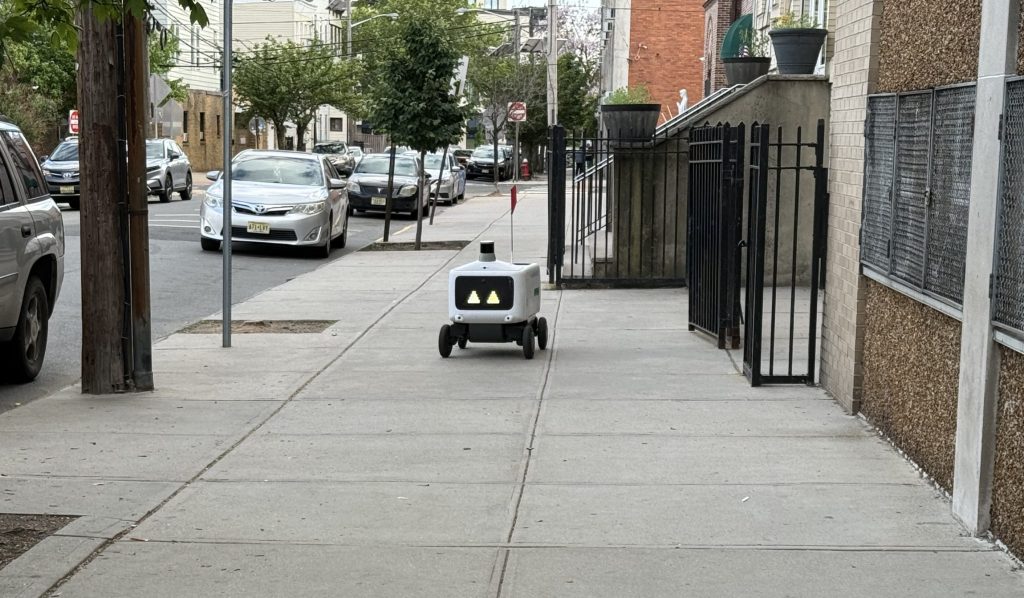
An Avride delivery robot rolls along a sidewalk in Jersey City. (Photo source: NJDOT BPRC)
Delivery robots are part of the e-commerce industry, and a market that is growing rapidly in the United States. Recent trends show that nearly 75% of restaurant orders are to-go, reflecting a surge in business occurring off restaurant premises. As a result, businesses are looking to make their operations more efficient, leading to the increased prevalence of delivery robots in urban spaces; one study found that their integration can reduce operational costs by up to 57% and energy consumption by up to 42%.
Delivery robots could eventually assist local planning and public works departments in capturing valuable data about sidewalks and roads, and companies may be willing to share data with cities to target accessibility issues. In fact, Hoboken recently announced it is piloting the use of robots to collect information on pedestrian infrastructure from July to August 2026. The “Daxbots” will record granular data about sidewalks, curb cuts, and other facilities in an effort to improve the ADA accessibility of Hoboken streets. These devices are capable of capturing detailed information that could be used to flag any obstructions, damage, or areas that fail to serve the needs of pedestrians. As a result, data collection and sharing could help evaluate compliance with the standards of the Americans with Disabilities Act (ADA), implement Complete Streets policy, and work towards Vision Zero. Sidewalk robots could also generate revenue for cities through advertisements or fees, offering a new opportunity to support accessibility data collection and fund street improvement projects.
Currently, delivery pilots in New Jersey and nationwide are raising questions about the use of data and how to ensure privacy. Outside Hoboken’s pilot which specifically seeks to collect accessibility data, other delivery-oriented pilots do not appear to store and share sidewalk data, despite tech companies underscoring the potential data benefits when proposing pilot programs to cities. Furthermore, as pilots roll out, some communities are expressing concerns that the privacy of residents will not be maintained. In Hoboken, the sidewalk robots are restricted from storing any personal information. Future adoption in new communities should be sure to include clear protocols and data collection policies that protect residents’ privacy.
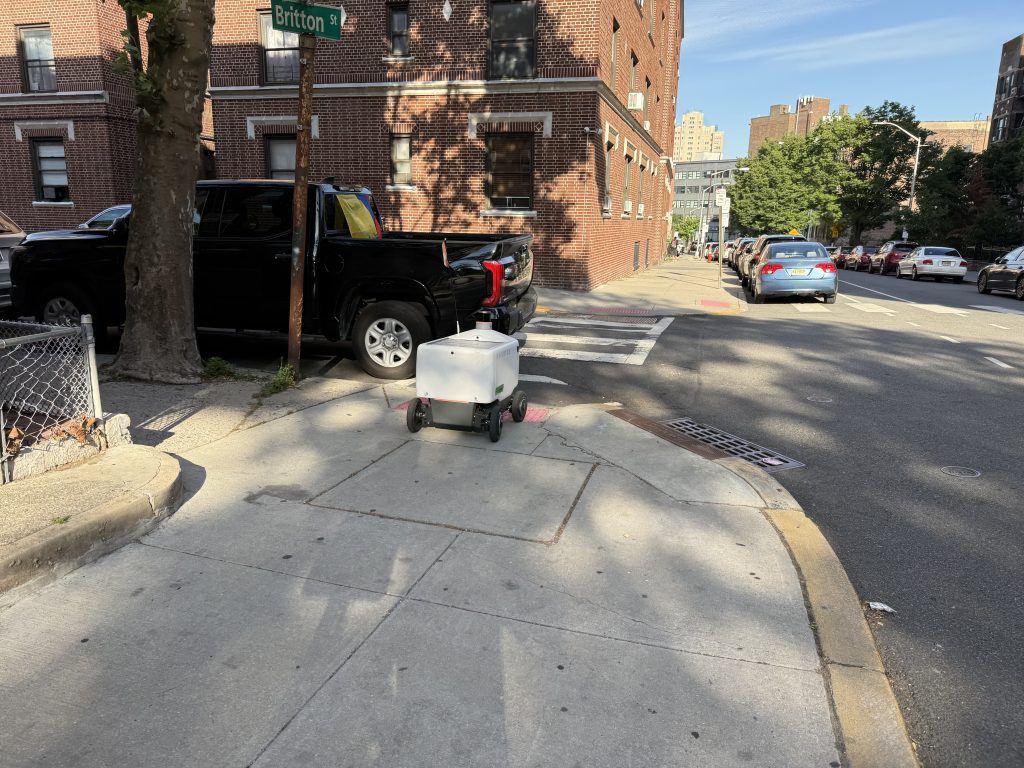
A delivery robot meets a crosswalk and curb cut that is obstructed by an illegally parked motor vehicle; the robot stops and evaluates whether its current route is still feasible. (Photo source: NJDOT BPRC)
Discussions about these robots have primarily been focused on potential safety and accessibility issues. While their dimensions and weights vary across cities, the particular robots deployed in Jersey City can move at speeds of up to five miles per hour, weigh up to 55 pounds, and reach over four feet tall including flags used for visibility. They share sidewalks with pedestrians of all ages and abilities. According to Avride, these robots have no need for continuous oversight, and they are designed to handle most challenges autonomously. Regardless, these robots ultimately are non-sentient and unable to rely on social norms to navigate unpredictable environments. It is unclear what protocols are in place for when safety systems fail and accountability must be taken on behalf of the robot. After a collision in Jersey City last year where a bicyclist was injured, for example, an Avride delivery robot appeared to immediately leave the scene before it was stopped by a bystander.
During emergencies, automated fleets of robots must be resilient and able to adapt to avoid further complicating difficult situations. For example, in December 2025, over 1,500 Waymo robotaxis stalled in the streets of San Fransico and required human assistance during a power outage, resulting in the hindering of response times from emergency services. Overall, autonomous delivery robots may pose safety issues for pedestrians, especially those already facing mobility challenges; and yet, they also hold promise for the future of restaurant and delivery operations and collecting data in public spaces within urban areas.
Delivery robots introduce new pressures on sidewalk space, and a regulatory framework for food delivery robots can help New Jersey’s municipalities weigh impacts alongside the potential benefits. Sidewalks are public, shared environments, and any rules governing delivery robots must prioritize safety, accessibility, and privacy while also considering private interests, such as technological innovation and business efficiency. While the manufacturing sector has been handling robot automation for decades, the current challenge is to identify where current governance falls short for robots that automate services and interact with the public.
Recent research highlights several governance gaps that directly affect sidewalk accessibility, including:
- Unclear expectations for how delivery robots should behave in shared spaces.
- Inconsistent incident reporting.
- Broad data‑collection practices which raise privacy concerns and weaken public trust.
The question now is whether creating new policies will prevent future conflicts. Will policies be able to set human‑oriented operating rules, standardize incident protocols, and limit private data retention? These measures could improve predictability and reduce risks, but their effectiveness will depend on how consistently they are implemented and enforced across the environments where people walk, roll, and bike.
References
Brennan, N., & Price, M. (2025, Nov 26). Hundreds of Chicago residents sign petition to pause robot delivery pilot program over safety concerns. https://www.cbsnews.com/chicago/news/north-side-residents-petition-pause-to-delivery-robots/
City of Hoboken. (2026, July 10). City launches robot-assisted sidewalk assessment to advance Vision Zero and ADA accessibility planning. https://www.hobokennj.gov/news/ada-robot
Delivery Robot . Avride. Retrieved May 28, 2026, from https://www.avride.ai/robot
Fuller, J., Chang, A. & Intagliata, C. (2026, Feb 9). Sidewalk delivery robots are colonizing city sidewalks and raising concerns. Retrieved May 28, 2026, from https://www.npr.org/2026/02/09/nx-s1-5703601/sidewalk-delivery-robots-are-colonizing-city-sidewalks-and-raising-concerns
Heath, R. (2026, May 14). ‘Sidewalks are not tech playgrounds.’ N.J. man injured in robot crash plans to sue. NJ.com. Retrieved May 28, 2026, from https://www.nj.com/hudson/2026/05/sidewalks-are-not-tech-playgrounds-nj-man-injured-in-robot-crash-plans-to-sue.html
Klar, R., Arvidsson, N., & Rudmark, D. (2025). Towards a new last-mile delivery system: Cost and energy-optimized robot and van allocation. Elsevier BV. https://10.1016/j.tre.2025.104392
Macgregor, G., & Young, M. (2025, Jan 30). Cities need to get ahead of autonomous delivery robots. Retrieved May 28, 2026, from https://policyoptions.irpp.org/2025/01/sidewalk-robot-delivery-safety/
Moe, L., & Andrews, C. (in press). Make Room for Robots. Issues in Science and Technology, , 58–63. http://issues.org/issue/42-4/
National Restaurant Association. (2025, April 16). From Trend to Transformation: Off-Premises Dining Now Essential for Restaurant Consumers, Operators. https://www.prnewswire.com/news-releases/from-trend-to-transformation-off-premises-dining-now-essential-for-restaurant-consumers-operators-302429894.html
Nava, M. (2025, Dec 16). The Future of Food Delivery Is Rolling Through Jersey City. https://medium.com/@navam2/the-future-of-food-delivery-is-rolling-through-jersey-city-2b9b0aa90534
Pozen, L., & Fioresi, D. (2025, Sept 21). West Hollywood man with cerebral palsy voices concerns after collision with delivery robot. https://www.cbsnews.com/losangeles/news/west-hollywood-delivery-robot-crash-pedestrian-cerebral-palsy/
Salvini, &., Pericle, Paez-Granados, &., Diego, Billard, &., & Aude. (2021). Safety Concerns Emerging from Robots Navigating in Crowded Pedestrian Areas. International Journal of Social Robotics, https://link.springer.com/article/10.1007/s12369-021-00796-4
Tu, M. (2026, May 18). Could Delivery Robots Help Pay For Better City Sidewalks? https://nextcity.org/urbanist-news/could-delivery-robots-help-pay-for-better-sidewalks
Yu, X., Hoggenmüller, M., Tran, T. T. M., Wang, Y., & Tomitsch, M. (2024). Understanding the Interaction between Delivery Robots and Other Road and Sidewalk Users: A Study of User-generated Online Videos. Association for Computing Machinery (ACM). https://10.1145/3677615
Zhang, &., Bingqing, Amirian, &., Javad, Eberle, &., Harry, Pettré, &., Julien, Holloway, &., Catherine, Carlson, &., & Tom. (2021). From HRI to CRI: Crowd Robot Interaction—Understanding the Effect of Robots on Crowd Motion
Empirical Study of Pedestrian Dynamics with a Wheelchair and a Pepper Robot. International Journal of Social Robotics, 14 https://link.springer.com/article/10.1007/s12369-021-00812-7