New Jersey has established itself as a national leader through its commitment to several ambitious policy goals, including eliminating traffic fatalities and serious injuries by 2040 and significantly reducing greenhouse gas emissions by 2050. Agencies are researching and implementing strategies that support the State in achieving its priorities. Micromobility options such as e‑bikes directly advance many of New Jersey’s transportation, environmental, and public health goals by providing a low‑emission, affordable, and accessible travel option.
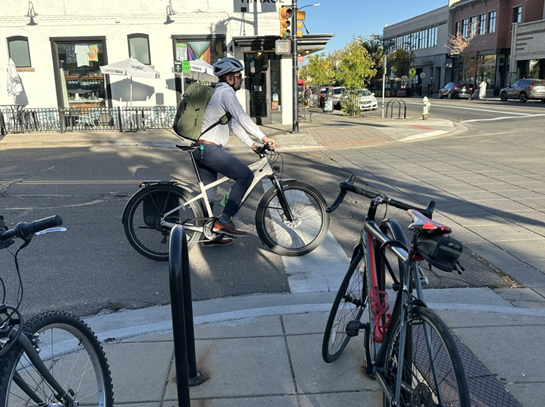
An e-bike rider waits at an intersection. (Photo: NJDOT BPRC)
Reducing Driving, Clean Energy, and Environmental Sustainability Goals
E-bikes and other micromobility options can provide alternatives to personal motor vehicle use by giving New Jersey residents convenient alternatives to driving. Data from the National Household Travel Survey indicates that the average motor vehicle trip in New Jersey is about 5 miles long, and about 55 percent of trips are under 3 miles. Providing more efficient alternatives for these shorter trips can reduce vehicle miles traveled (VMT) across the state, which can help advance several statewide priorities.
The New Jersey Department of Environmental Protection released the New Jersey Zero-Emission Vehicle Roadmap, outlining strategies to move the state away from a carbon-based economy. The roadmap highlights how micromobility options can replace many trips traditionally made by cars.
Reducing driving also supports the New Jersey Board of Public Utilities’ goal of achieving 100% clean energy by 2050 and lowering air pollution, both outlined in the 2024 New Jersey Energy Master Plan. In 2020, transportation accounted for 38% of New Jersey’s emissions. One of the plan’s key strategies focuses on reducing energy use and lowering emissions from the transportation sector. Another strategy focuses on limiting air pollution across the state. Lower pollution levels from the transportation sector can help reduce asthma, cancer, and other chronic health conditions in communities with higher air pollution. Internationally, electric micromobility, like e-bikes and e-scooters, was estimated to reduce global demand for oil by a million barrels per day in 2022; the study by Bloomberg New Energy Finance noted that the worldwide estimate for electric vehicles was almost 20 million that year, but in the same year there were over 280 million electric micromobility devices, including electric mopeds, e-scooters, and e-bikes.
Micromobility options, such as e-bikes, produce no direct emissions and can help reduce greenhouse gas and air pollution from the transportation sector. Encouraging wider use of micromobility can help New Jersey become more energy-efficient and environmentally sustainable.
New Jersey Zero Emission Vehicle Roadmap. (Photo: NJ Department of Environmental Protection)
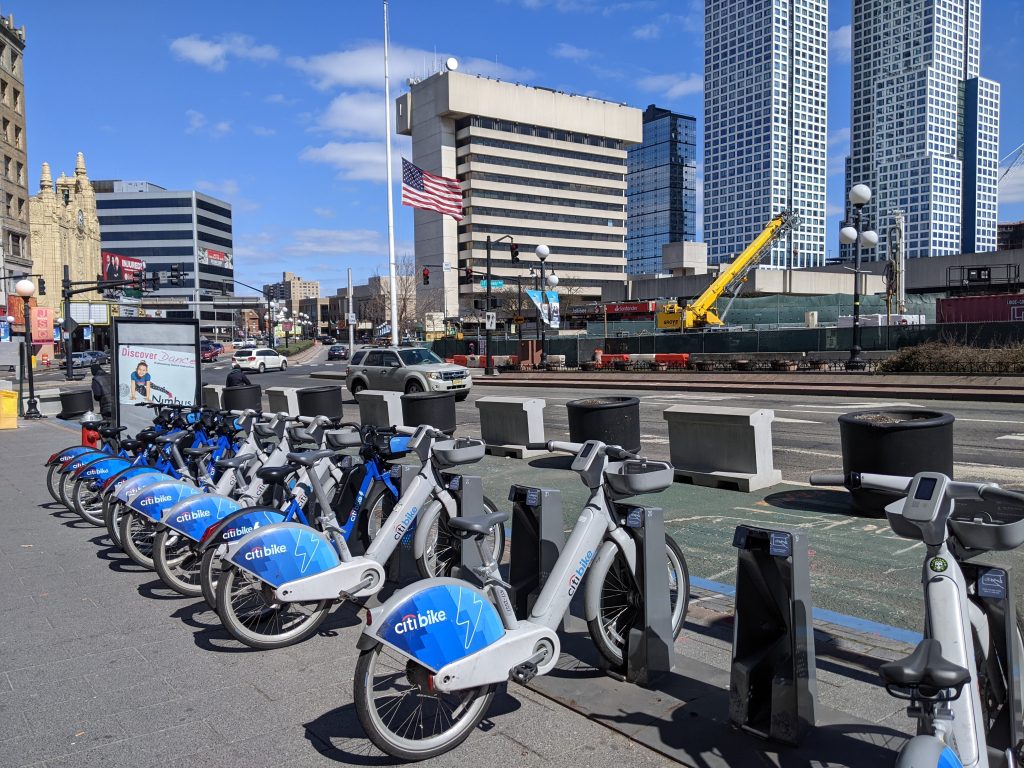
Shared e-bikes can provide a mobility alternative that supports dense growth and car-free access to transit hubs. (Photo: NJDOT BPRC)
Economic Development, Improved Connectivity, and Increased Accessibility
Micromobility and e-bike initiatives can support economic development and improve connectivity across New Jersey. Using micromobility and e-bikes, people can more easily access shops, restaurants, and employment centers that would otherwise require a car. Greater access can directly benefit Main Street businesses and support job growth across the state.
Research from the League of American Bicyclists found that people who travel to local businesses by bicycle spend more money overall, an average of $70 more per month, compared to individuals who drive. Cargo- and e-bikes can also support goods movement in dense downtown areas, reducing the need for large delivery trucks in busy pedestrian corridors while maintaining efficient delivery of goods. The combined benefits can help reduce traffic congestion on roadways, strengthening local economies.
Micromobility and e-bikes can also play an important role for individuals living with disabilities who cannot obtain a driver’s license or use a traditional pedal bicycle. Devices such as e-bikes can support independent travel and improve personal mobility throughout New Jersey. Improved mobility can also make it easier to access public transportation, essential services, and economic opportunities.
Safety and Increasing Active Transportation Network Connectivity
New Jersey has committed to eliminating traffic fatalities and serious injuries by 2040, with strategies outlined in the New Jersey Target Zero Action Plan. Micromobility and e-bike users are identified in the plan as key populations in need of better infrastructure that can help create safer conditions. The Action Plan encourages expanding active transportation networks to provide more protected on-road bicycle facilities and to develop a statewide greenway network connecting communities together.
Investments in micromobility infrastructure, including protected bike lanes and secure parking and charging facilities, can encourage more residents to choose micromobility for more trips. Expanded infrastructure can also strengthen New Jersey’s active transportation network and make alternative transportation options easier to use.
Recent news has raised understandable safety concerns about e‑bikes, but it helps to look at them in context. A study out of Rutgers University reviewed hospital injury data to find that e-scooters and e-bikes do not cause more injuries than traditional bicycles, and compared with cars, e‑bikes are much lighter and operate at far lower speeds and carry far less kinetic force in a collision than cars. Because e‑bikes and other micromobility devices are slower and lighter than motor vehicles, they pose substantially less risk to other roadway users. Importantly, many e‑bike trips replace short car trips, reducing the number of heavy, high‑speed vehicles on the road.
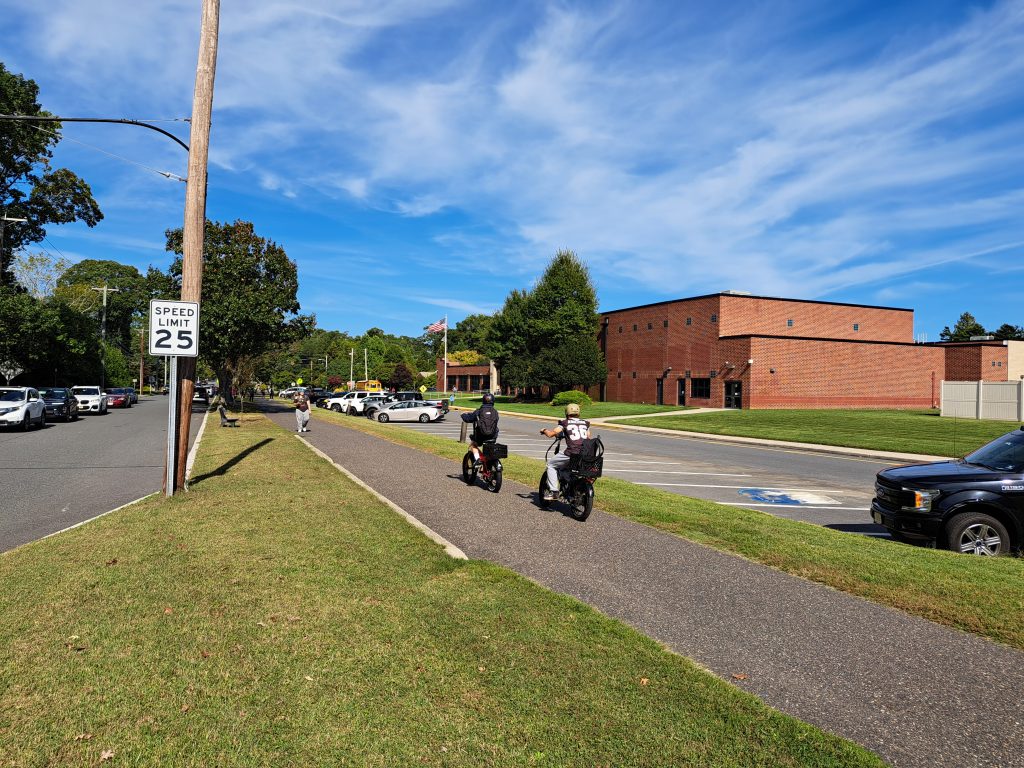
Shared-use paths provide dedicated space for micromobility users at all ages to ride safely. (Photo: NJDOT BPRC)
It is also important to distinguish low-speed electric bicycles and other micromobility devices—which legally do not exceed an assisted speed of 20 miles per hour—from e-motos, which are heavier, much faster, and are legally considered motorcycles. Seen this way, well‑regulated e‑bikes are not a step backward for safety, but a practical tool for lowering overall traffic risk. A study by the Mineta Transportation Institute found that higher-speed e-motos are often misidentified as e-bikes and offers recommendations that aim to increase e-bike use while also improving safety for both e-bike riders and all other road users.
The Bottom Line
Micromobility and e-bikes offer an innovative opportunity to support several statewide priorities. Continued investment in infrastructure, policies, and programs supporting micromobility and e-bikes can help make micromobility a larger part of New Jersey’s long-term transportation, clean-energy, economic, and safety goals, such as:
- Fewer Car Trips, Cleaner Air: Micromobility options like e‑bikes can replace many short car trips, reducing vehicle miles traveled, emissions, and air pollution while supporting New Jersey’s clean energy and climate goals.
- Economic Benefits and Job Access: E‑bikes improve access to jobs, businesses, and services, support local economies, and expand mobility options for people without access to cars, including low-income households and individuals with disabilities.
- Safer, More Connected Transportation: Investments in protected infrastructure strengthen New Jersey’s active transportation network and make using micromobility safer. And replacing short car trips with e-bike trips reduces overall traffic risk.