The NJDOT Bicycle and Pedestrian Resource Center and Rowan University have recently released a new report: Systemic and Systematic Safety Countermeasures for Vulnerable Road User Safety: A Review. The report examines the increasing safety concerns for vulnerable road users, particularly pedestrians and bicyclists, amid rising numbers of traffic crashes. It highlights the need for comprehensive safety strategies through systemic and systematic approaches, emphasizing data-driven decision-making.
A systemic approach proactively identifies high-risk roadway features contributing to crashes, while a systematic approach applies proven safety countermeasures consistently across the transportation network. Both approaches are crucial to addressing risk for all road users on public roads. The Safe System Approach (SSA) integrates these strategies to reduce fatalities by focusing on safer people, speeds, roads, vehicles, and post-crash care. The report provides a detailed review of existing safety frameworks, crash data analysis methods, and real-world case studies, offering actionable insights for policymakers, engineers, and researchers to enhance pedestrian and bicyclist safety.
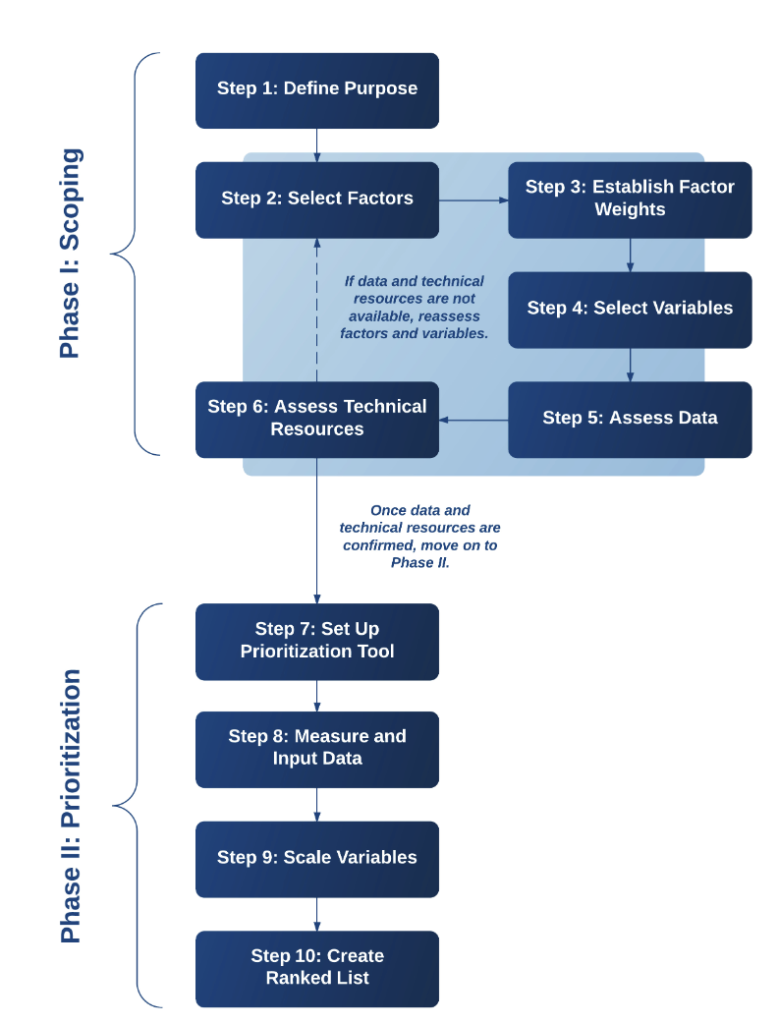
The ActiveTrans Priority Tool methodology defines a process for identifying risk based on roadway characteristics. (Source: Lagerwey et al. 2015)
Report Highlights
The paper highlights the importance of data-driven solutions in improving bicyclist and pedestrian safety by systemic and systematic approaches. It compares various evaluation systems and their methodologies for project and countermeasure selection.
- The Safe System Roadway Design Hierarchy model aligns with the SSA and identifies safety countermeasures to be integrated into transportation projects.
- The United States Road Assessment Program (usRAP) tool provides “star ratings” and risk maps to proactively identify high-risk locations.
- The ActiveTrans Priority Tool (APT) allows transparency and customizability to help develop a prioritized list of pedestrian and bicycle projects based on crash data or other behavioral data, if available.
- The Systemic Safety Project Selection Tool identifies high-risk roadway features correlated with severe crashes and prioritizes low-cost, widespread countermeasures at all locations sharing those features, even if a specific site has no prior history of crashes.
- The Highway Safety Manual offers a “Six-Step Roadway Safety Management Process,” a crash data-driven approach to identifying, diagnosing, and evaluating the economic effectiveness of safety treatments.
- The Pedestrian and Bicyclist Intersection Safety Indices (PBISI) leverages a methodology to identify high-risk intersections based on relative risk to vulnerable road users.
The Vision Zero Network is a national movement of communities taking up systemic and systematic approaches to reduce fatal and serious injury crashes. Case examples show how both approaches have brought success worldwide. Locally, initiatives in Jersey City, Hoboken, and Middlesex County, New Jersey have brought safer road design, speed reductions, and fatal and serious injury crash reductions. These examples are highlighted in the paper.
New York City’s Turn Calming Program is another example of successful pedestrian injury reduction, while Philadelphia’s parking-separated bike lanes and Portland’s bike boxes have promoted safe bicycle usage. Crashes in school zones have been reduced through Santa Monica’s road diets, while in Florida, improved LED lighting increased visibility at night for pedestrians and reduced fatal crashes. These examples show how site-specific safety can work, even as such issues as money, political resistance, and uneven data collection persist.
To address these challenges, the report recommends increased data collection, adoption of Complete Streets policies that integrate systematic safety improvements, additional grant funding, increased public awareness, and greater collaboration with stakeholders. It notes that long-term success can be achieved through ongoing use and evaluation of safety tools. Systemic and systematic safety approaches, along with policy support and community participation, are required for safe transportation environments and reduced traffic fatalities.
The full report is available here.
Analise Draghi, Greg Woltman
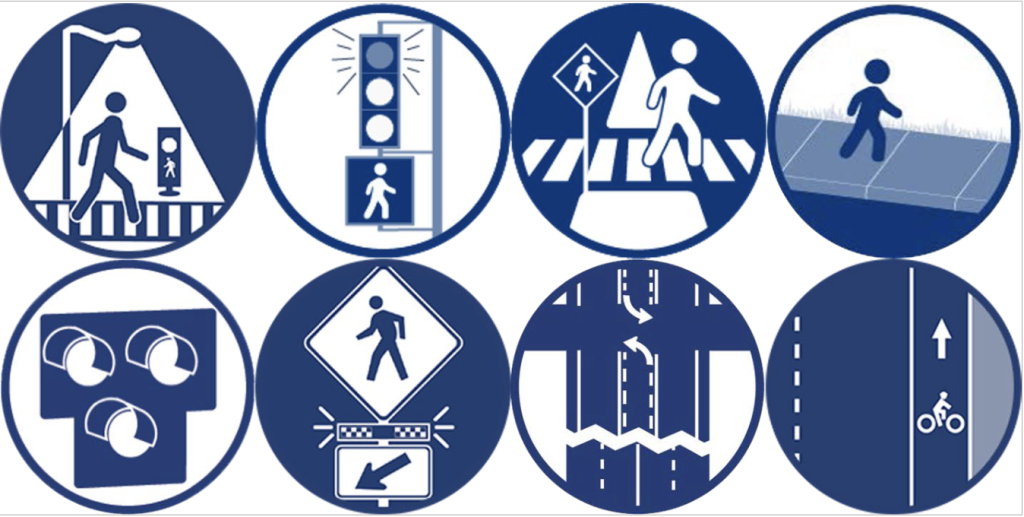
Proven Safety Countermeasures provide evidence-based solutions for systematically increasing the safety of local streets and roads. (Source: Federal Highway Administration’s Proven Safety Countermeasures)