Complete Streets Training Resources for New Jersey Communities
Complete Streets are designed for all users, all modes of transportation, and all abilities. They respond to local needs and context, such as roadway type, topography, natural features, density of development, adjacent land use, and street connectivity. Since 2010, NJDOT and its partners have offered Complete Streets training for local communities. These trainings are designed for planners, engineers, advocates, public health professionals, policymakers, elected officials, and anyone looking to learn more about Complete and Green Streets. Trainings cover topics including:
- The benefits of implementing Complete Streets.
- The evolution of Complete Streets as a safety strategy, policy, and planning and design concept, including emerging trends that are informing how we think about Complete Streets.
- The integration of planning and placemaking with Complete Streets and the vast opportunities to make places safer and more livable through these synergies.
- Best practices for Complete and Green Streets design guidance.
Resources from the most recent training sessions are available below.
2026 New Jersey Complete Streets Training
Sponsors: South Jersey Transportation Planning Organization, Sustainable Jersey, Cross County Connection TMA, the Voorhees Transportation Center at Rutgers University, and the New Jersey Department of Transportation
Format: One webinar and one in-person training based on NJDOT training slides
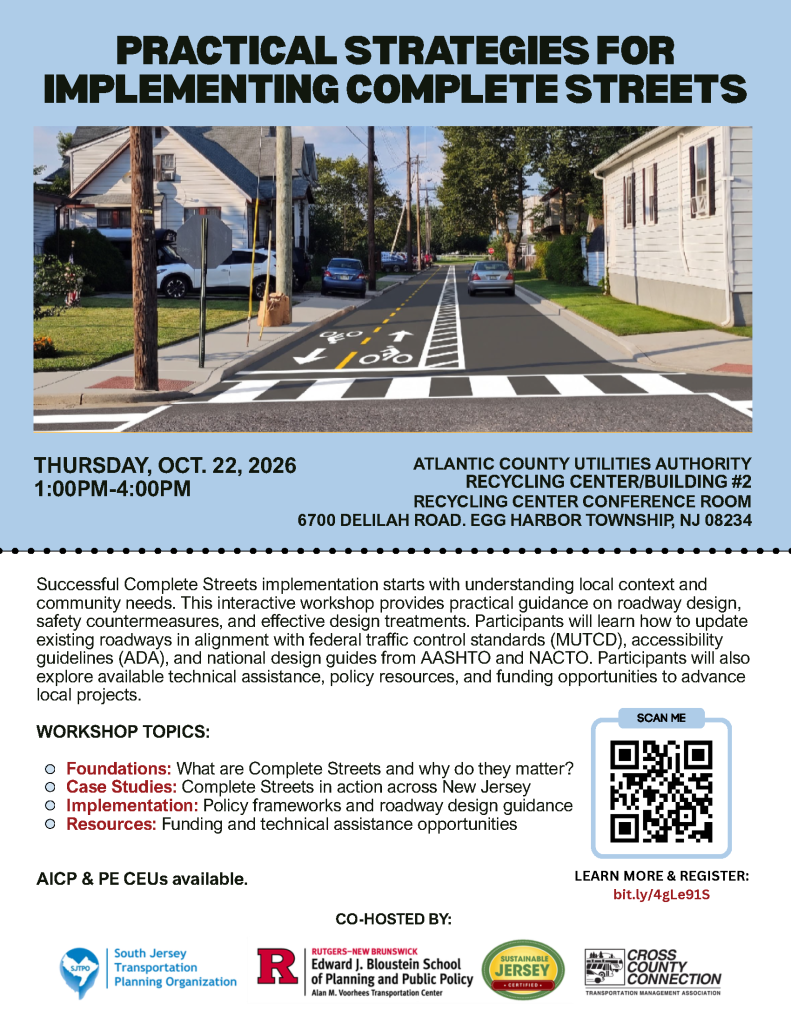
Training 1: Practical Strategies for Implementing Complete Streets
Successful Complete Streets implementation starts with understanding local context and community needs. This interactive workshop provides practical guidance on roadway design, safety countermeasures, and effective design treatments. Participants will learn how to update existing roadways in alignment with federal traffic control standards (MUTCD), accessibility guidelines (ADA), and national design guides from AASHTO and NACTO. Participants will also explore available technical assistance, policy resources, and funding opportunities to advance local projects.
AICP & PE CEUs are available. While the course is targeted at planners and engineers, other professionals, elected officials, and advocates from anywhere in New Jersey are welcome to attend. Registration is now open.
Thursday, October 22, 2026, 1:00pm-4:00pm
Atlantic County Utilities Authority, Recycling Center/Building #2
Recycling Center Conference Room
6700 Delilah Road, Egg Harbor Township, NJ 08234
Register for free here: bit.ly/4gLe91S
Training 2: Complete Streets in Action: Policy Webinar
This one-hour webinar will detail how adopting a Complete Streets policy can enhance safety and transform mobility across your municipality or county. This webinar provides practical guidance on policy implementation, including access to customizable templates, real-world best practices, and actionable strategies. The webinar will also highlight key emerging initiatives, such as NJ Target Zero and Local Safety Action Plans, to help you advance safety in your local community. AICP & PE CEUs are available.
Wednesday, December 9, 2026
Registration opens in October!
2024-2025 New Jersey Complete Streets Training: Implementing Complete Streets at the Local Level
Sponsors: South Jersey Transportation Planning Organization, Sustainable Jersey, Cross County Connection TMA, the Voorhees Transportation Center at Rutgers University, and the New Jersey Department of Transportation
Format: One webinar and one in-person training based on NJDOT training slides
Resource: Webinar recording
Complete Streets are designed for all users, all abilities, and all modes of transportation. They respond to local needs and context, such as roadway type, topography, natural features, density of development, adjacent land use, and street connectivity. SJTPO sponsored two interactive training sessions covering all aspects of Complete Streets.
Training 1: What are Complete Streets and How to Craft and Implement an Effective Municipal Policy
Learn how to create and adopt your own custom municipal Complete & Green Streets Policy! This online-only session was designed for planners, advocates, public health professionals, policymakers, elected officials, and anyone looking to learn more about Complete and Green Streets and how to adopt and implement a policy to design safer, greener, and more accessible streets for your community.
During the webinar we provided detail information on the following:
- What are Complete Streets and the costs of incomplete streets
- Policy paradigms for safer streets and how to achieve zero deaths
- What needs to be included in a municipal policy to ensure effective implementation
- How to get local buy-in and policy stewardship
Thursday, January 23, 2025, 12:00pm-1:30pm
Training 2: Complete Streets Design, Funding and Implementation
Learn about the latest design guidance for creating safer roadways for all users and which funding sources are available to support implementation. This in-person-only training session was designed for engineers, planners, advocates, elected officials, and anyone looking to learn more about building safer streets.
This in-person interactive workshop focused on the following topics:
- The latest state and federal design guidance
- Considerations of local context
- The Safe System Approach
- Proven Safety Countermeasures
- Temporary Demonstration Projects
- Review of key funding opportunities
Thursday, January 30, 2025, 1:00pm-4:00pm
Rowan College of South Jersey – Cumberland County
2022 New Jersey Complete Streets Training
Sponsors: New Jersey Department of Transportation
Format: Webinar
Resource: PDF version of presentation slides (see below)
Three online trainings were held in 2022. Each training focused on a different region of the state, but all sessions covered the same basic principles and were open to everyone. PDF versions of the 2022 training slides are linked below:
If you use any portion of the training content, we request that you cite NJDOT Complete Streets Training, Fall 2022.
Session 1
Thursday, October 13, 2022, 9 am – 12 pm
North Jersey focus
- Bergen County
- Essex County
- Hudson County
- Morris County
- Passaic County
- Sussex County
- Warren County
Session 2
Thursday, October 20, 2022, 9 am – 12 pm
Central Jersey focus
- Hunterdon County
- Mercer County
- Middlesex County
- Monmouth County
- Ocean County
- Somerset County
- Union County
Session 3
Thursday, October 27, 2022, 1 pm – 4 pm
South Jersey focus
- Atlantic County
- Burlington County
- Camden County
- Cumberland County
- Cape May County
- Gloucester County
- Salem County
Course Outline
Module 1 – Benefits
Module 1 focuses on WHY Complete Streets are important and their far-reaching benefits, including safety, resiliency, equity, and health, and best practices for Complete Streets policies and procedures. This module covers the fundamentals of Complete Streets: what they are, how they reflect local contexts, the high costs of “incomplete” streets, the benefits of implementation, recent emerging trends, and how to advance Complete Streets policies in your own community.
Module 2 – Planning
Module 2 describes WHAT goes into planning for a balanced network of Complete Streets in a community, including deploying demonstration projects and understanding local context. This module describes the planning stage of the implementation process: why planning beforehand is essential, community collaboration, planning and zoning for Complete Streets, using data to measure success and target projects for the greatest impact, and how to educate staff and the general public.
Module 3 – Design
Module 3 focuses on HOW to design a Complete Streets project within the context of a community and includes an interactive project development and design exercise. This module describes the design stage of the implementation process: defining a clear vision and achievable goals, understanding local context and diverse travel needs, assessing overall system performance, and the Safe Systems Approach, including FHWA Proven Safety Countermeasures. This module also examines street typologies within the New Jersey Complete Streets Design Guide.